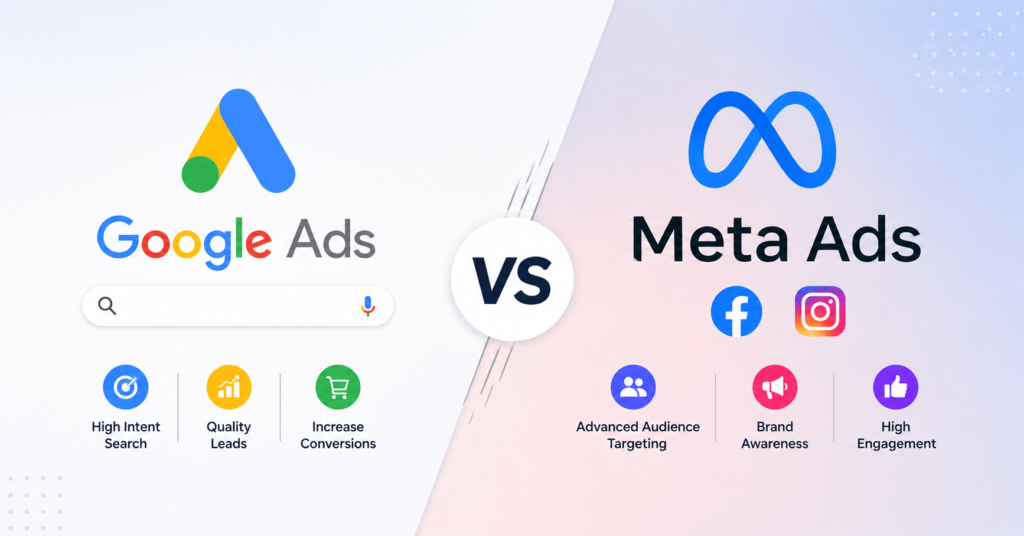
Google Ads vs Meta Ads is one of the most common comparisons for businesses looking to advertise online. Both platforms help businesses reach potential customers, increase sales, and grow their brand, but they work in different ways. While Google Ads targets people actively searching for products or services, Meta Ads focuses on reaching audiences through Facebook and Instagram. In this guide, we’ll compare Google Ads vs Meta Ads to help you choose the best platform for your business in 2026.
Which one is better? It’s all in what your business requires and who your audience is. In this article, we’ll compare Google Ads vs Meta Ads and find out which platform is the right one for your business in 2026.
—
What Are Google Ads?
The Google Ad is what Google calls its advertisement platform which uses Google Search, Google Maps, YouTube, Gmail, and other websites using the Google Display Network to advertise products.
One of the biggest advantages of Google Ads is that it focuses on people who are already searching for products or services. As a result, businesses can reach users with high purchase intent. Therefore, Google Ads often deliver quality leads and better conversion rates.
Types of Google Ads
- Search Ads
- Display Ads
- Shopping Ads
- Video Ads (YouTube)
- Performance Max Campaigns
- App Promotion Ads
What Are Meta Ads?
Meta Ads appear on Facebook, Instagram, Messenger, and the Meta Audience Network. Unlike Google Ads, they focus on discovering potential customers instead of targeting people actively searching online. As a result, Meta Ads are highly effective for increasing brand awareness and engagement. Meta Ads are characterized by a highly advanced targeting audience mechanism.
Types of Meta Ads
Image Ads
Video Ads
Carousel Ads
Collection Ads
Reels Ads
Story Ads
Lead Generation Ads
Comparison of Google Ads vs Meta Ads
1. User Intent
Google Ads
People using Google are already searching for something.
Such as:
“Top digital marketing agency near me”
“Buy running shoes online”
“Restaurant in Kochi”
These users have strong purchase intent, making Google Ads ideal for businesses looking for immediate enquiries or sales.
Meta Ads
Social media users on Facebook and Instagram are engaging in content consumption as opposed to product searching.
Meta Ads disrupt the scrollable screen of users with appealing visuals to create interest.
This makes Meta Ads excellent for introducing your business to new customers.
Winner: Google Ads (for purchase intent)
—
2. Audience Targeting
Both Google Ads and Meta Ads offer advanced audience targeting. However, they use different methods to reach potential customers. While Google Ads rely on keywords and search intent, Meta Ads focus on user interests, behaviours, and demographics.
Google Ads
Google mainly targets users based on:
Keywords
Search intent
Location
Device
Language
Audience signals
Meta Ads
Meta allows businesses to target users based on:
Age
Gender
Interests
Behaviours
Relationship status
Job title
Education
Previous interactions
Custom audiences
Lookalike audiences
Meta offers some of the most detailed audience targeting available.
Winner: Meta Ads
—
3. Cost
Advertising costs vary depending on your industry and campaign goals. Generally, Google Ads have a higher Cost Per Click (CPC). However, these clicks often convert better because users already have buying intent. In contrast, Meta Ads usually offer lower CPC and CPM, making them a budget-friendly option for many small businesses.
Google Ads
Google Ads usually have a higher Cost Per Click (CPC), especially in competitive industries such as:
Real Estate
Healthcare
Finance
Legal Services
However, these clicks often convert better because users are actively searching.
Meta Ads
Meta Ads usually have a reduced CPC and Cost Per Thousand Impressions (CPM).
Companies with tight advertising budgets find it cheaper to use Meta Ads.
Winner: Meta Ads (cost-effective option)
4. Lead Quality
Lead quality is often more important than lead quantity. Because Google users are actively searching, the leads generated through Google Ads are usually more qualified. On the other hand, Meta Ads help businesses reach new audiences who may not be ready to buy immediately. Therefore, some additional follow-up may be needed before these leads convert into customers.
Google Ads
Leads generated via Google Ads are more likely to be qualified because users search on purpose.
A user who searches for “SEO services in Kerala” needs an SEO service provider.
Meta Ads
Meta Ads generate interest among users who may not have been planning to buy immediately.
While lead volume may be higher, some leads require additional nurturing before converting into customers.
Winner: Google Ads
—
5. Brand Awareness
If your goal is to increase brand awareness, Meta Ads are an excellent choice. For example, Instagram Reels, Stories, and Facebook Ads allow businesses to showcase products using engaging visual content. Meanwhile, Google Ads support brand awareness through Display and YouTube campaigns.
Winner: Meta Ads
—
6. Speed of Results
Both platforms can produce results quickly. However, Google Ads often generate enquiries faster because users already have purchase intent. Meanwhile, Meta Ads may require more time for optimisation. Once the algorithm understands your target audience, campaign performance usually improves significantly.
Once optimisation is complete, Meta campaigns can produce excellent long-term results.
—
7. Best Businesses for Google Ads
Google Ads work well for:
- Local businesses
- Digital marketing agencies
- Doctors and clinics
- Lawyers
- Hotels
- Restaurants
- Real estate companies
- Educational institutions
- Home service providers
- E-commerce stores
8. Best Businesses for Meta Ads
Meta Ads are ideal for:
- Clothing brands
- Beauty products
- Restaurants
- Gyms
- Salons
- Cafés
- Jewellery businesses
- Online courses
- Personal brands
- Influencers
- Lifestyle businesses
Google Ads Pros
- Google Ads provide high purchase intent.
- Google Ads generate quality leads.
- Google Ads offer immediate visibility.
- Google Ads include detailed reporting.
- Google Ads are great for local businesses.
- Google Ads work well for service-based companies
Google Ads Cons
- Google Ads can have a higher CPC.
- Google Ads require ongoing optimisation.
- Google Ads can be competitive in popular industries.
Meta Ads Pros
- Lower advertising costs compared to many search campaigns.
- Advanced audience targeting based on interests and behaviour.
- Excellent for building brand awareness.
- Strong engagement through Facebook and Instagram.
- Ideal for visually appealing products and services.
- Supports Reels, Stories, Carousel, and Video Ads.
Meta Ads Cons
- Lower purchase intent than search advertising.
- High-quality creatives are essential for good performance.
- Leads often require follow-up before converting.
Google vs. Meta Ads – Which One to Choose for Your Business?
The decision will depend on your business requirements
Go for Google Ads if you aim at:
- High-quality leads
- Increase website enquiries
- Target people searching for your services
- Drive immediate sales
- Improve local visibility
Select Meta Ads when you desire to:
- Raise brand awareness
- Gain new customers
- Promote offers and events
- Grow your social media presence
- Build customer engagement
- Why Many Businesses Use Both
Rather than select just one option, many companies which are doing well use both Google Ads and Meta Ads.
For example:
- Use Meta Ads to introduce your brand and build awareness.
- Retarget interested users with Meta Ads.
- Capture high-intent customers through Google Search Ads.
- Keep nurturing your customers through remarketing campaigns.
- It is so because such advertising campaigns will help you connect with potential customers in all buying stages.
Platform That Will Provide More Return on Investment
It is not an easy question to answer
When a person is searching for something they want to purchase, the Google Ad can deliver a higher ROI.
In cases where you need to create awareness and build relationships, then the Meta Ad can deliver an incredible ROI.
Companies that have understood the strength of both platforms can leverage them well in delivering a high ROI.
Conclusion
In conclusion, choosing between Google Ads vs Meta Ads depends on your business goals rather than one platform being universally better. If your goal is to generate high-intent leads and immediate conversions, Google Ads are an excellent choice. On the other hand, if you want to increase brand awareness, engage your audience, and build long-term relationships, Meta Ads can deliver outstanding results. Ultimately, many successful businesses combine both platforms to create a complete digital marketing strategy that drives sustainable growth. Therefore, investing in the right advertising platform—or using both together—can help your business attract more customers, increase sales, and stay ahead of the competition.
Overall, choosing between Google Ads vs Meta Ads depends on your business goals rather than one platform being universally better.