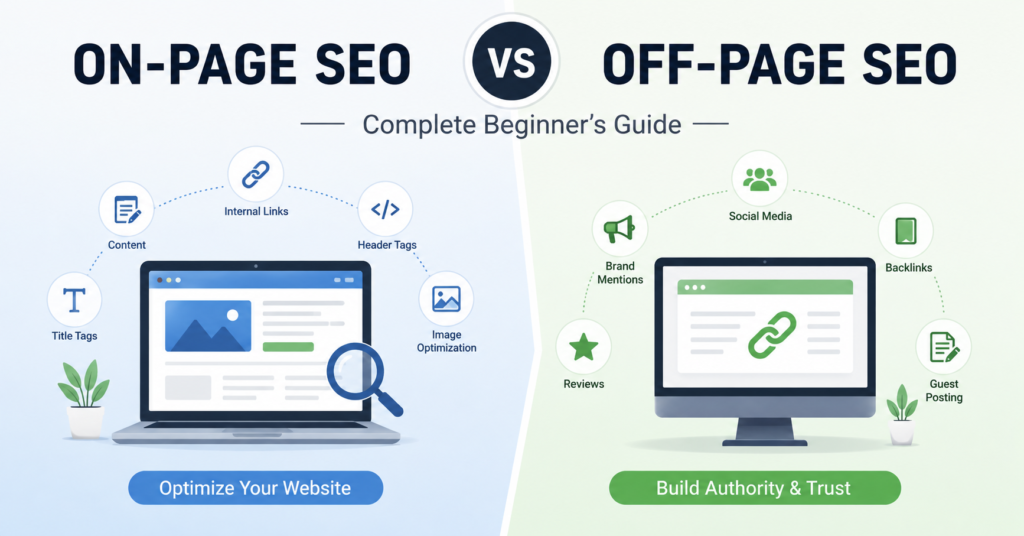
On-Page SEO vs Off-Page SEO is an important topic for anyone who wants to improve a website’s visibility in search engines. Whether you run a large company, a small business, an e-commerce website, or a personal blog, understanding the difference between On-Page SEO and Off-Page SEO can help you build a stronger digital marketing and SEO strategy.
On-Page SEO focuses on optimizing elements within your website, while Off-Page SEO focuses on activities outside your website that can help build authority, credibility, and visibility. Although both approaches have different purposes, they work together to improve your website’s overall search performance.
In this guide, we’ll explore the key differences between On-Page SEO and Off-Page SEO, explain the most important techniques used in each approach, and show you how to create a balanced SEO strategy.
What Is On-Page SEO? Key On-Page SEO Techniques
On-Page SEO refers to the activities you perform on your own website to help search engines understand your content and provide a better experience for visitors.
This includes improving your content, page structure, headings, URLs, images, internal links, and other elements of your webpages.
For a broader introduction to SEO, you can also explore our SEO basics guide.
1. Keyword Optimization for On-Page SEO
Keywords are the words and phrases people enter into search engines when looking for information, products, or services.
Using relevant keywords naturally throughout your content can help search engines understand the topic of your page.
For example, if you write about digital marketing strategies, you might naturally include related terms such as:
- Online marketing
- SEO strategies
- Content marketing
- Digital marketing techniques
However, keywords should always be used naturally. Excessive repetition, known as keyword stuffing, can make content difficult to read and may negatively affect the user experience.
2. High-Quality Content for On-Page SEO
Content is one of the most important parts of On-Page SEO.
Your content should be:
- Original
- Useful
- Relevant
- Accurate
- Easy to understand
- Created for your target audience
A high-quality blog post should answer the questions your audience is searching for and provide genuine value.
For example, if you are writing about keyword research, your article should help readers understand how to identify relevant search terms and use them effectively.
3. Title Tags and On-Page SEO
The title tag tells search engines and users what a webpage is about. A clear and relevant title can also encourage users to click on your page in search results.
For example:
On-Page SEO vs. Off-Page SEO: A Complete Guide for Beginners
Your primary topic or focus keyphrase should be included naturally in the title when appropriate.
4. Meta Descriptions in On-Page SEO
A meta description is a short summary of a webpage that may appear below the title in search results.
Although a meta description is not generally considered a direct ranking factor, a clear and compelling description can encourage users to click on your result.
For this article, a suitable meta description could be:
Learn the difference between On-Page SEO vs Off-Page SEO, explore key techniques, and discover how to build a balanced SEO strategy.
5. Header Tags
Using headings such as H1, H2, and H3 helps organize your content into logical sections.
Well-structured headings make an article easier for readers to scan and help search engines understand the organization and context of your content.
For example, this article uses headings such as:
- What Is On-Page SEO?
- Key Elements of On-Page SEO
- What Is Off-Page SEO?
- Key Elements of Off-Page SEO
- On-Page SEO vs. Off-Page SEO: Key Differences
6. Internal Linking
Internal links connect one page on your website to another page on the same website.
For example, an article about SEO could link to related content about:
- Keyword research
- Technical SEO
- Content marketing
- Local SEO
- SEO analytics
Internal linking helps visitors discover related content and can help search engines understand the structure and relationships between pages on your website.
You can learn more by reading our guide to technical SEO.
7. URL Optimization
A simple and descriptive URL can make it easier for users and search engines to understand what a page is about.
For example:
example.com/on-page-seo-vs-off-page-seo
is generally clearer than:
example.com/page123?id=456
Whenever possible, use short, descriptive URLs that accurately reflect the topic of the page.
8. Image Optimization
Images can improve the visual appeal and usefulness of your content, but they should also be optimized.
Consider using:
- Descriptive file names
- Appropriate image dimensions
- Compressed image files
- Relevant alt text
For example, an image comparing the two SEO approaches could use the alt text:
“On-Page SEO vs Off-Page SEO comparison showing website optimization and external authority-building techniques”
Descriptive alt text can improve accessibility and provide search engines with additional context about an image.
What Is Off-Page SEO?
Off-Page SEO refers to activities that happen outside your own website that can influence your website’s authority, reputation, visibility, and ability to compete in search results.
While On-Page SEO focuses on improving your website itself, Off-Page SEO focuses on building credibility and awareness around your website.
Key Elements of Off-Page SEO
1. Backlinks
Backlinks are links from other websites to your website.
When relevant and reputable websites link to your content, those links can act as signals of credibility and authority.
However, quality is generally more important than quantity. A small number of relevant, trustworthy links can be more valuable than a large number of low-quality or manipulative links.
The goal should be to earn links naturally by publishing useful content and building genuine relationships.
2. Digital PR
Digital PR involves promoting your business, expertise, research, or content through online publications, news websites, industry platforms, and other relevant media channels.
Being mentioned by reputable websites can increase brand awareness, generate referral traffic, and potentially lead to valuable editorial links.
3. Social Media Promotion
Sharing content on platforms such as Instagram, Facebook, LinkedIn, and X can help increase visibility and bring more people to your website.
Social media activity should not be viewed as a direct replacement for SEO. However, social platforms can help your content reach a wider audience and create opportunities for engagement, brand awareness, and natural link earning.
4. Brand Mentions
When people discuss your business or brand online, it can help increase awareness and establish your presence within your industry.
For example, a digital marketing agency mentioned in industry blogs, podcasts, interviews, or online publications may gain greater visibility among potential customers.
Building a recognizable brand can complement your broader SEO efforts.
5. Guest Blogging
Writing useful articles for relevant third-party websites can help you reach new audiences and build relationships within your industry.
Guest contributions should focus primarily on providing genuine value to readers. When appropriate and editorially earned, they may also generate referral traffic and relevant links.
6. Local SEO Activities
For local businesses, Off-Page SEO can include maintaining accurate business information across relevant online directories and earning genuine customer reviews.
These activities can help strengthen a business’s local online presence.
If you operate a local business, you may also want to learn more about local SEO strategies.
On-Page SEO vs. Off-Page SEO: Key Differences
The easiest way to understand On-Page SEO vs Off-Page SEO is to remember:
On-Page SEO = Optimizing your website
Off-Page SEO = Building your website’s reputation and authority outside your website
| On-Page SEO | Off-Page SEO |
|---|---|
| Focuses on your website | Focuses on activities outside your website |
| Optimizes content and webpages | Builds authority and reputation |
| Includes keywords and headings | Includes backlinks and digital PR |
| Improves content and user experience | Builds relationships and brand awareness |
| Includes internal linking | Includes earning relevant external links |
| Mostly under your direct control | Often depends on third parties |
Both approaches work toward the broader goal of improving your website’s visibility and helping it perform better in organic search.
Which One Is More Important?
The answer is simple: both are important.
Imagine you have created an excellent website with helpful content, well-optimized pages, and a good user experience. This gives you a strong foundation for On-Page SEO.
However, if your website has little visibility or recognition within its industry, it may be difficult to compete for highly competitive search queries.
On the other hand, building external authority without useful, relevant, and well-optimized content can also limit your results.
That’s why a successful SEO strategy should combine both approaches.
Think of it this way:
On-Page SEO helps make your website valuable and understandable.
Off-Page SEO helps build awareness, credibility, and authority around your website.
Together, they form a more complete SEO strategy.
How to Create a Balanced SEO Strategy
If you’re starting your SEO journey, consider following these steps.
Step 1: Create High-Quality Content
Start by understanding what your audience wants to know.
Research the questions, problems, and topics that matter to your target audience, then create useful content that addresses their needs.
Focus on providing genuine value rather than creating content solely to target keywords.
Step 2: Optimize Your Webpages
Improve important on-page elements, including:
- Page titles
- Headings
- URLs
- Images
- Internal links
- Content structure
- Keyword usage
Make sure every page has a clear purpose and provides useful information to visitors.
Step 3: Improve User Experience
Make sure your website is:
- Easy to navigate
- Mobile-friendly
- Accessible
- Fast and technically sound
- Easy to read
- Helpful to visitors
A good user experience can make it easier for visitors to find the information they need and engage with your website.
Step 4: Build Relationships
Connect with relevant businesses, industry experts, publishers, creators, and professional communities.
Building genuine relationships can create opportunities for collaboration, exposure, digital PR, and naturally earned links.
Step 5: Promote Your Content
Share your content through appropriate channels, such as:
- Social media
- Email newsletters
- Industry communities
- Professional networks
- Relevant online publications
The goal is to put useful content in front of people who may find it valuable.
Step 6: Earn Quality Backlinks
Focus on creating valuable resources that other websites naturally want to reference.
You can also explore legitimate digital PR and outreach opportunities, provided your approach is relevant, useful, and focused on earning genuine editorial recognition.
Step 7: Monitor Your Performance
Use SEO and analytics tools to track meaningful metrics such as:
- Organic traffic
- Search visibility
- Keyword rankings
- Click-through rates
- Conversions
- Engagement
- Leads or sales
Regularly review your results and adjust your strategy based on what you learn.
For more information, consider reading our guide to SEO analytics and performa0nce tracking.
Conclusion
Understanding On-Page SEO vs Off-Page SEO is essential for building a strong search engine optimization strategy.
On-Page SEO helps search engines understand your website and ensures that visitors find useful, relevant, and well-structured content. Off-Page SEO, meanwhile, focuses on building credibility, authority, awareness, and relationships beyond your own website.
Instead of choosing between the two, businesses should aim for a balanced SEO strategy that combines website optimization with genuine authority-building activities.
By creating valuable content, optimizing your webpages, improving user experience, building relationships, promoting your content, and earning quality backlinks, you can create a stronger foundation for long-term organic search visibility.
In short: optimize what you control, build trust beyond your website, and focus on creating real value for your audience.